Heavy Metals in Henna Dye — Water Henna's Lead, Arsenic, Cadmium Results
Water Henna's heavy-metal test found lead, arsenic, antimony and cadmium not detected, and nickel at 1.7 μg/g — far below the 10 μg/g standard, and less than the nickel naturally in spinach, tomato or tangerine.

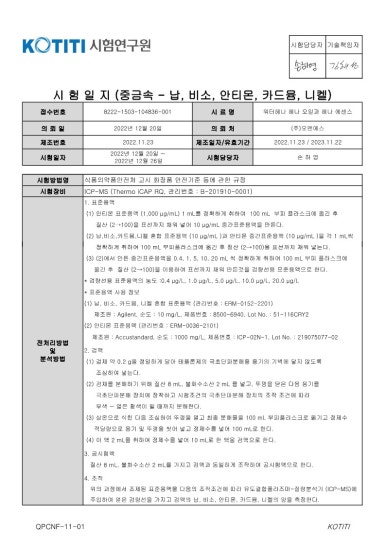
A customer who had seen news reports of heavy metals in henna wrote to ask about Water Henna's levels, so here is a summary of the testing. The short version: lead, arsenic, antimony and cadmium were all not detected, and only nickel appeared, at 1.7 μg/g — far below the 10 μg/g standard.
What Did the Test Find?
In testing conducted under Korea's MFDS notified "Regulation on Cosmetic Safety Standards," lead, arsenic, antimony and cadmium in Water Henna were all not detected. Nickel came in at 1.7 μg/g — well under the 10 μg/g limit — and was judged to present no issue.
So Why Does Nickel Show Up at All?
When I asked why nickel appears, the reason was that a trace comes off the blades as henna is ground into powder in India. Because Water Henna is filtered and made into a liquid, even that trace ends up far from the limit.
Nickel is in fact common in the food we eat daily. Green and black tea bags, made from chopped leaves, run very high at 60–250 μg/g; chocolate, potato chips, flour and coffee, whose ingredients must be milled, come in around 10–60 μg/g. Naturally, celery, peanuts, kimchi, tangerine, beans, oatmeal, shellfish, onion, corn, spinach and tomato all contain nickel at 2–8.5 μg/g. It is the sort of amount a home blender produces — nothing to fear. (Though, as someone who drinks nearly ten coffees a day, I will admit my eyes widened a little here.)
In the End, Can You Relax?
To sum up, Water Henna's heavy metals are trace enough that you could call them absent. Nickel at 1.7 μg/g is less than in green tea or coffee, and even less than the nickel naturally in spinach, tomato or tangerine (2–8.5 μg/g). It meets the cosmetic safety standard, so please use it with peace of mind. If you would like to see the full ingredient picture, have a look at Water Henna's eleven ingredients.
Read next
- Water Henna's Full Ingredients — Just 11, Fewer Than Ice CreamIngredients & Safety · 2 min read
- Is Natural Henna Dye Free of Bacteria? On Microbes and How We Manage ThemIngredients & Safety · 3 min read
- Is PPD the Only Carcinogen in Hair Dye? Chemical Colorants and Natural HennaIngredients & Safety · 3 min read
- Amazon Review — The Customer Who Called Water Henna 'Henna Gods'Stories · 3 min read